Find out what the sample leaves out
A wallpaper cutting can contain one leaf and a little background while the full design includes a bird, a large flower and long areas of empty space. Before deciding that you love the pattern, find the full repeat image and its measurements. You need to know what will appear between the attractive details in your sample.
A room photograph is helpful, but it may show a much taller ceiling or a less interrupted wall than yours. Use the pattern dimensions to imagine the design at the actual height of your room. A flower that looks modest in a showroom image may occupy much of the wall above a low sideboard.
Ask whether the available sample shows a full repeat. If it does not, a larger sample or a visit to a display can help. Little Greene, for example, distinguishes its smaller samples from the larger examples available through stockists. The point is not to insist on a particular sample size; it is to understand which parts of the design you have and have not seen.
Give the pattern an actual wall
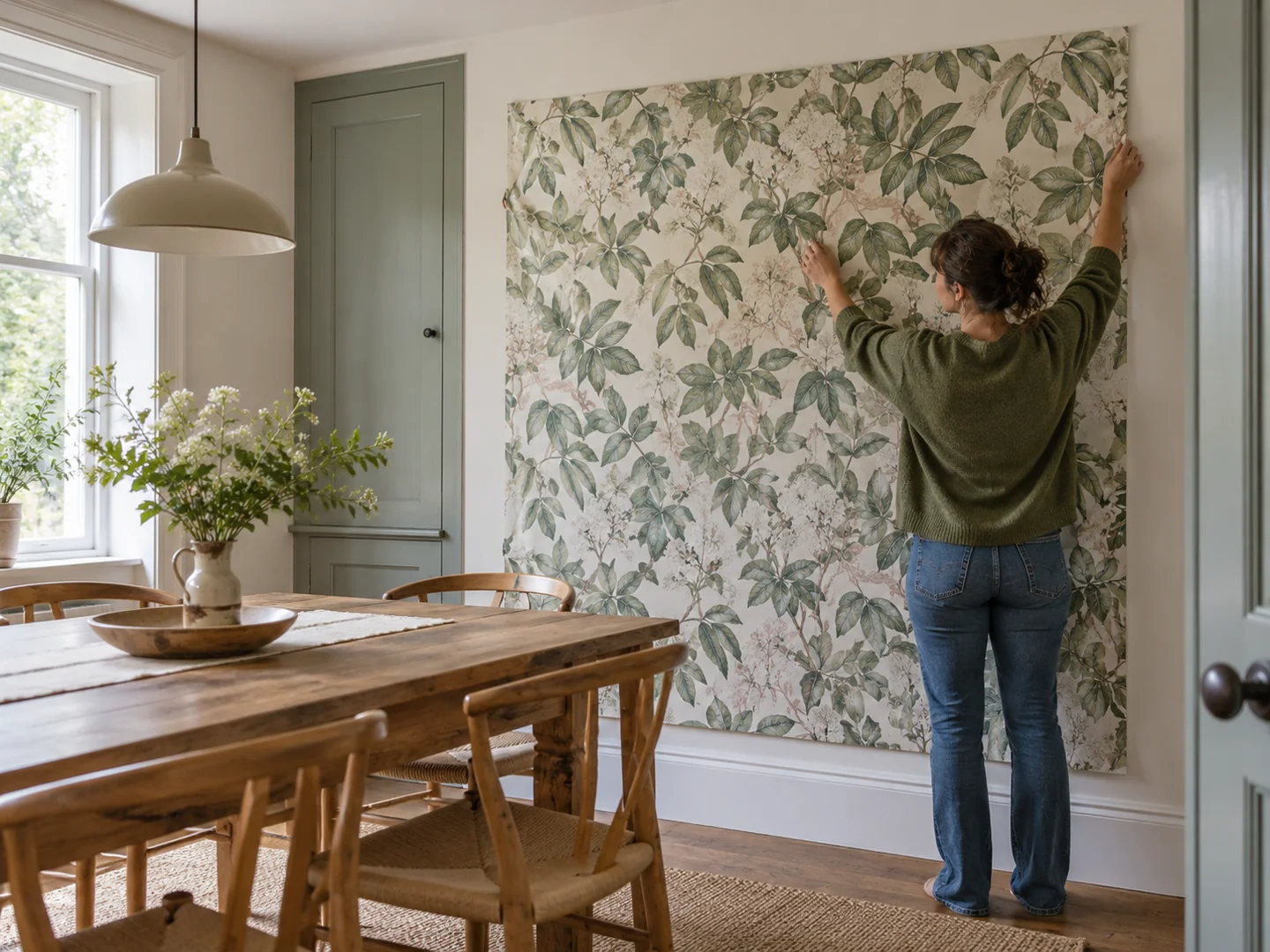
Choose the intended wall before judging scale. Behind a sofa, a large amount of paper will be hidden at the bottom. Around a window, the design will appear in narrow strips. In an uncluttered hallway, the same pattern may be seen as a broad uninterrupted field.
Draw the wall on paper with the main furniture and openings included. Mark a few repeats at roughly the right scale. This is not an installation plan, but it can reveal whether a large motif will be chopped into small fragments or whether a small repeat will read mainly as texture from the doorway.
There is no universal rule that a small room needs small wallpaper. A large, open pattern can feel less busy than a tiny high-contrast one. Compare the amount of background, the strength of the outlines and the distance between motifs as well as their size.
Think about your usual viewing distance. Beside a breakfast table you may see every printed detail. Across a sitting room you may mainly see the pattern's rhythm and colour. Both views matter if the room is used in different ways.
Check the furniture that sits in front
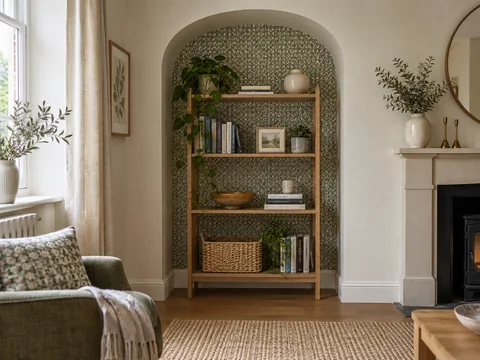
A busy bookcase, a patterned sofa and a strongly patterned wall can work together, but the result needs to be wanted rather than accidental. Put samples of the largest textiles beside the wallpaper. Compare pattern scale as well as colour: a broad botanical design and a tiny check create a different relationship from two similarly sized florals.
Look at the outline of the furniture. A dark sideboard may make a pale wallpaper seem clearer; a pale open shelf can disappear against a light background while its contents become the main pattern. Avoid choosing from an empty-wall photograph if the finished wall will be full of objects.
Artwork deserves a trial too. A picture with a generous plain mount may remain distinct against a pattern. An unframed busy print may compete. You do not need to remove all artwork, but decide which pieces will still have enough visual space.
Watch the pattern at the boundaries
Corners, door frames and ceiling lines divide a design. A strict grid or stripe makes those boundaries more conspicuous than a loose organic motif. In an older room, look at whether the walls and openings are visibly out of square before choosing a pattern that will sit directly beside them.
Pattern matching affects how much material is needed. Use the exact wallpaper's repeat and hanging instructions when planning quantities; a simple calculation of wall area can miss the material lost while aligning drops. A product calculator is a starting point, and complicated walls may warrant advice from the supplier or installer.
Keep all order details together, including the product code, colourway and batch information. Similar names can refer to different versions. Do not substitute a nearly matching roll partway through the job without checking with the supplier.
Make the final choice in ordinary light
Put the sample on more than one part of the intended wall and look at it in the room's normal evening lighting. Metallic or textured details can become much more visible when light strikes from the side. A pattern that looks subtle flat on a table may feel stronger once vertical.
Live with the sample alongside the furniture for a few ordinary days if time allows. You are looking for a pattern you still enjoy when a coat is on the chair and the table has papers on it. If the design needs an entirely empty room to look comfortable, either simplify the surrounding scheme or choose a quieter paper.
When you can picture the whole repeat, its position behind furniture and its behaviour at the room's edges, the purchase becomes less of a leap. The prettiest detail on a cutting is still part of the decision, but it no longer has to carry the whole wall.