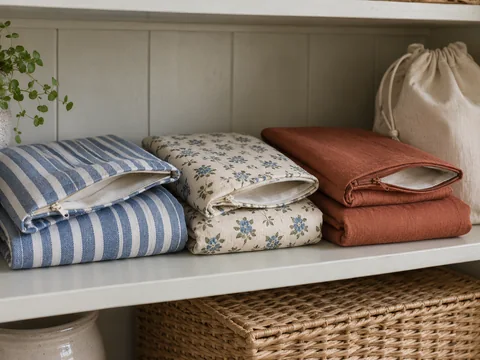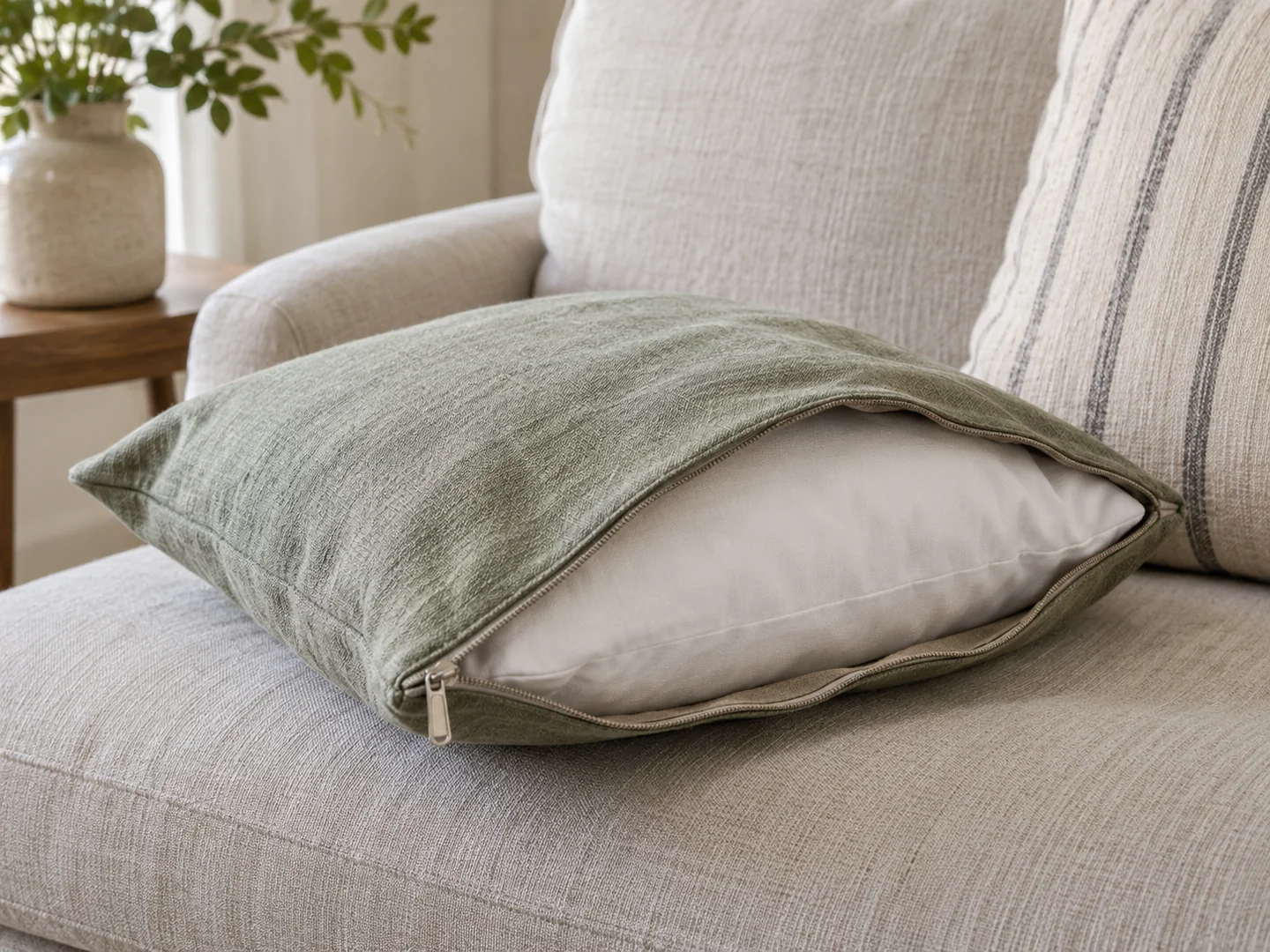
Try the cover and pad as a pair
A cushion cover is not a complete description of the cushion. Its insert determines much of the thickness, firmness and shape, and those qualities affect both appearance and comfort. Before replacing a cover that looks tired, check whether the pad has simply lost the form you want.
Measure the cover according to the seller's guidance and compare it with the recommended insert. Some suppliers suggest a particular pad size for their covers, but there is no useful rule that every cushion should contain an oversized insert. Too much filling can strain seams or make a shallow sofa uncomfortable.
Check the fastening. The zip should close without being forced, and the corners should be filled in the way the cover was designed to sit. A rounded or deliberately relaxed cover does not need to imitate a sharply squared showroom cushion.
Different fillings have different handling and care needs. Read the product information rather than assuming every feather, down or synthetic pad behaves identically. Consider personal preferences and any relevant sensitivities when choosing, and do not treat a decorative cushion as a medically prescribed support.
Test the pad on the actual furniture. A plump insert can look appealing but move you too far forward on a shallow seat. A flatter pad may be more comfortable while giving a softer outline. If the cushion is mainly used against an arm, test that position as well as a straight-backed sit.
Keep cover and insert instructions together. One may be washable while the other needs a different method, and both need to be fully ready for use before reassembly. A zip does not automatically mean the complete cushion can go in the washing machine.
If buying several, begin with one combination where possible. It is easier to judge a single pad inside the real fabric than to predict the result from filling weights alone. Once the size and feel work, record the details so future replacements are chosen for that cover instead of by guesswork.