Draw the table twice
Record the closed and fully extended dimensions as separate footprints. Keep the centre point in the right place: some designs extend equally at both ends, while others gain length at one end. A plan that assumes the table stays centred may not match the mechanism you buy.
Add chairs to both outlines. The extended table should not force a diner against a cupboard or leave someone unable to pull their chair back. Check the doors and routes nearby with every place occupied. If a table works only after other furniture moves, decide exactly where that furniture will go.
Ask how the extension happens
Some leaves store inside the table; others need a separate dry, protected place. Check the leaf's dimensions and weight, and whether one person can operate the mechanism as instructed. A table that extends easily in a spacious showroom may be harder to handle close to a wall at home.
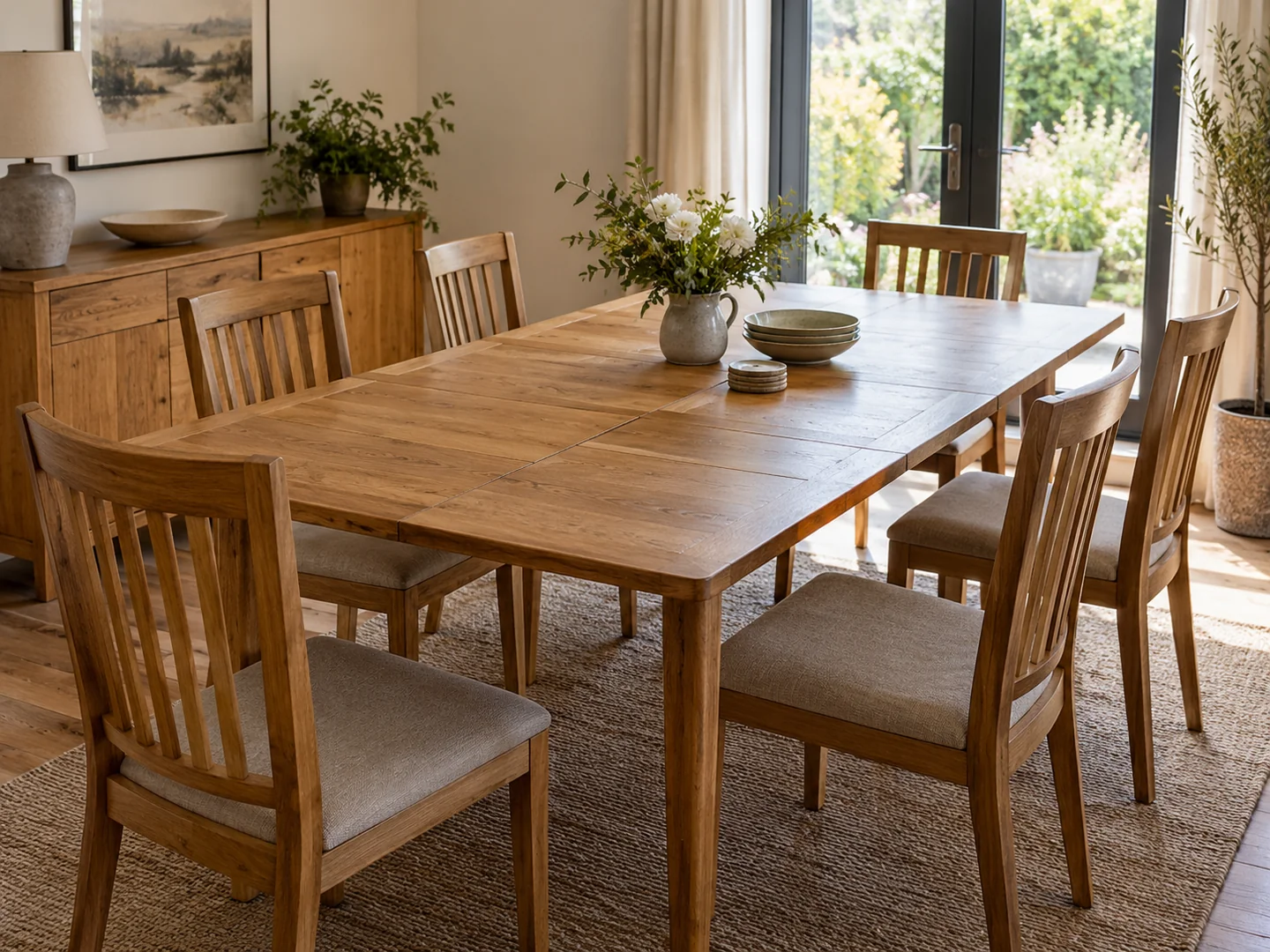
Look at where the legs end up when the table opens. On some designs they travel outward; on others the extra surface projects beyond them. Those arrangements affect where an additional diner can sit. Ask to see the table extended rather than relying on a photograph of the closed version.
Check the underside as well as the top. Mechanism rails and braces can reduce room for knees or prevent an armed chair from fitting beneath. If you plan to use existing chairs, take their measurements with you. The combination needs to work in both table positions.
Ask about the seam between the main top and the extension. It may be largely unobtrusive in daily use, but it can affect where a large serving board or a sheet of paper lies. Check how the leaf locks into place and whether the top feels steady when used as instructed. These are product-specific observations worth making during a demonstration, not assumptions to draw from the table's style.
If the leaves are stored separately, keep them in the conditions and position specified by the maker. A garage wall or the space behind a radiator may not be suitable for a timber panel. Confirm the storage plan before choosing a design with removable parts.
Store the extra setting
The additional chairs need a home on ordinary days. Stacking or folding designs may be suitable, but only if you can store them somewhere accessible and use them comfortably. A guest chair borrowed from a desk can work occasionally if its height suits the table; it should not be an untested assumption.
Table linen is another small consequence. A cloth that fits the closed setting may not fit the extension. Consider whether you prefer separate sizes, a runner or placemats that can be added individually. These details do not determine the furniture purchase, but they affect how easily you use its second configuration.
Try a realistic hosting rehearsal on the floor plan. Include the person serving food, the cupboard where dishes live and the way to leave the room. An extending table is useful when the larger arrangement can be set up without turning the whole home into temporary storage. Its value comes from a change you will actually make, not from the largest number printed on the label.