Draw the bay as it is
A bay window is a small arrangement of walls and angles, not simply a wide flat window. Begin with a rough plan viewed from above. Mark each straight section, the corners, the window handles and any projecting sill. Add a radiator, window seat or furniture that will remain nearby.
Measure each section separately and label the numbers on the sketch. Do not assume the left and right returns are equal because they look symmetrical. Older bays can contain small differences that matter when a track follows the shape closely.
At this stage, collect the room's dimensions rather than trying to invent a finished curtain size. The eventual order measurements depend on the chosen track or pole system, bracket projection and curtain heading. Keeping the raw observations separate makes it easier to follow a supplier's specific measuring process later.
Choose how the curtains will travel
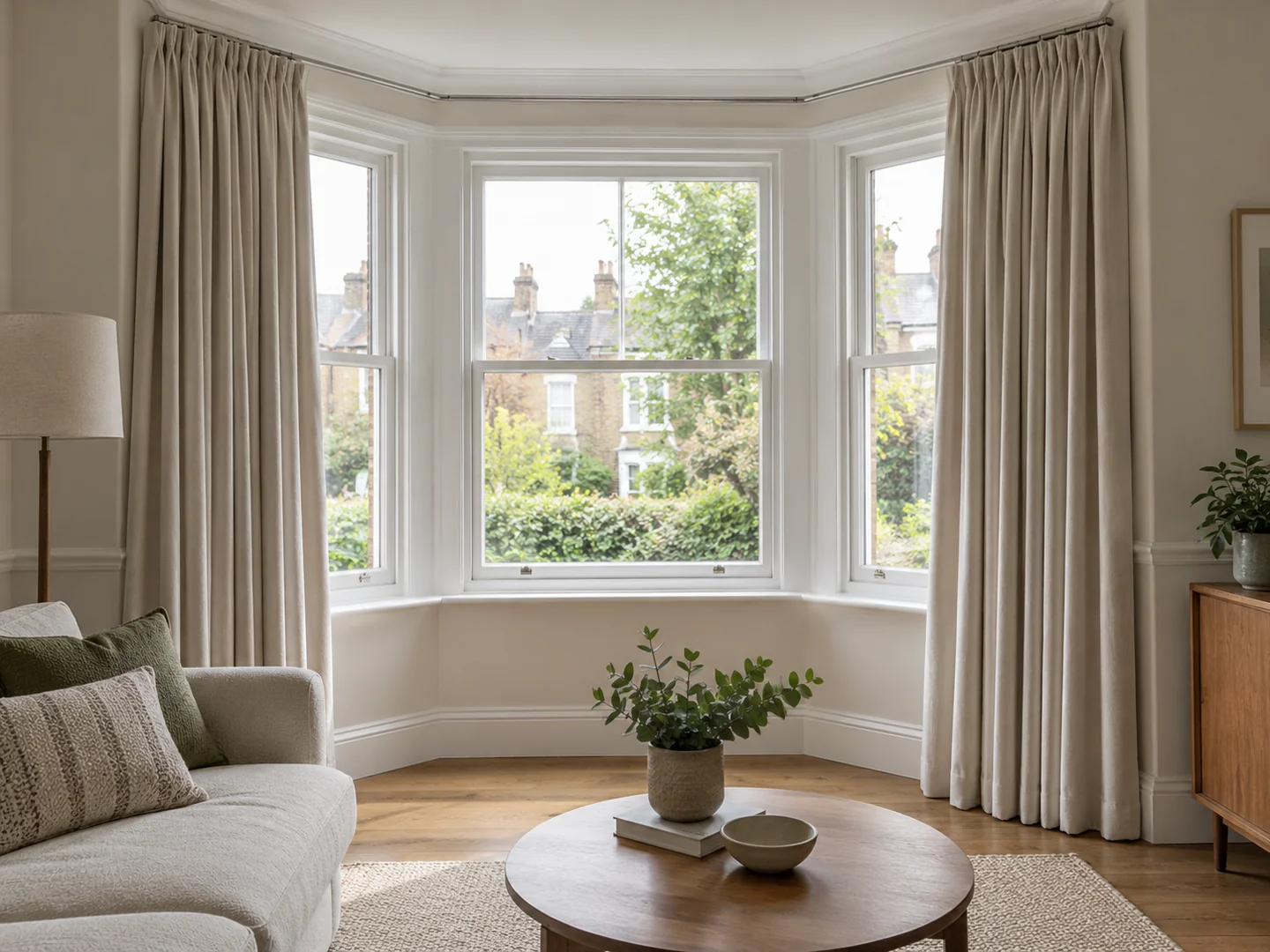
Decide whether curtains should run around the bay or sit across its front. Following the bay can preserve the shape as part of the room, while a straight covering across the opening creates a different boundary when closed. Neither arrangement is suitable for every bay, so consider the window seat, floor space and access needed.
For a track that follows the angles, check whether curtains can travel around the corners and past any supports as required. Some systems use particular gliders or passing components; others divide the curtain into separate sections. Do not combine parts from different systems on the assumption that all rings and brackets work alike.
A bay pole may look attractive in a photograph but need more clearance than expected. Check the chosen curtain heading's space in front of and behind the pole, especially near side walls and handles. A broad fold has depth, not just width.
Account for the open fabric
Curtains that close neatly still need a place to sit when open. Identify the intended stacking points and how much window they will cover. A deep lined curtain can occupy a substantial amount of space on a narrow return.
If you want the glass largely clear during the day, discuss stacking space with the supplier before choosing the fabric and heading. You may need a different opening arrangement or lighter construction. Buying extra fabric without considering the stack can reduce the daylight you wanted the bay to provide.
Look at the room from the sofa. A stack may be unobtrusive from directly in front yet dominate the side view. If a chair sits close to the return, check that the fabric will not be trapped behind it whenever somebody sits down.
Keep the windows and heat source accessible
Open the window handles and note their full movement. The track position must leave enough room for the intended operation, subject to the window and covering manufacturers' guidance. Do not base the arrangement on permanently keeping a window shut merely to prevent the curtain catching.
If a radiator sits within the bay, plan the closed curtain position as well as the open one. The fabric should not block the heater or breach its clearances. A window seat can also affect the drop: fabric that looks graceful beside an empty bay may gather awkwardly on cushions or storage lids.
Check access to any ventilation controls and the route used for cleaning. These are ordinary tasks that are easy to forget while looking at a front-on room image.
Use the system’s measuring sequence
Once the hardware has been selected, follow its measuring instructions exactly. A supplier may request angles, wall lengths, bracket positions or a template. Another may use an on-site measuring service. Their requirements should not be mixed into a hybrid set of numbers.
Dunelm's track and pole guidance, for example, treats measuring along the intended bay route as a distinct task. The point is to measure the path the curtain system will occupy, not just add the widths of the glass panes. For an awkward bay or expensive custom order, professional measurement may be worth arranging.
Confirm who allows for bends, brackets, overlaps and finished curtain fullness. A clear written order should identify the system, opening arrangement, fabric, lining, heading and drop. Keep a copy of the annotated sketch so later questions can be answered without measuring from memory.
Consider operation and safety together
If the system uses a cord or chain, follow its safety requirements and make sure the operating position is suitable. RoSPA notes that corded curtain tracks can present the same child strangulation risks as blind cords. Do not solve a difficult operating position by leaving a long loose loop accessible.
The completed bay should allow the curtains to move, the windows to be used and the room to function with its furniture in place. That is a more demanding test than whether a track fits the outline, but it catches the problems most likely to become daily irritations.