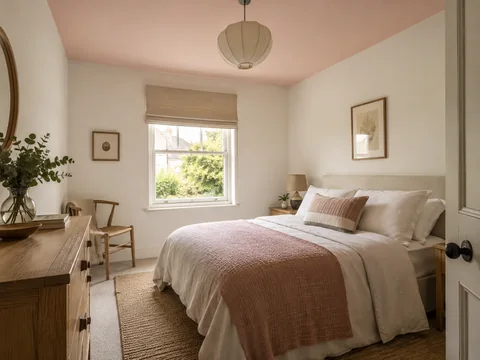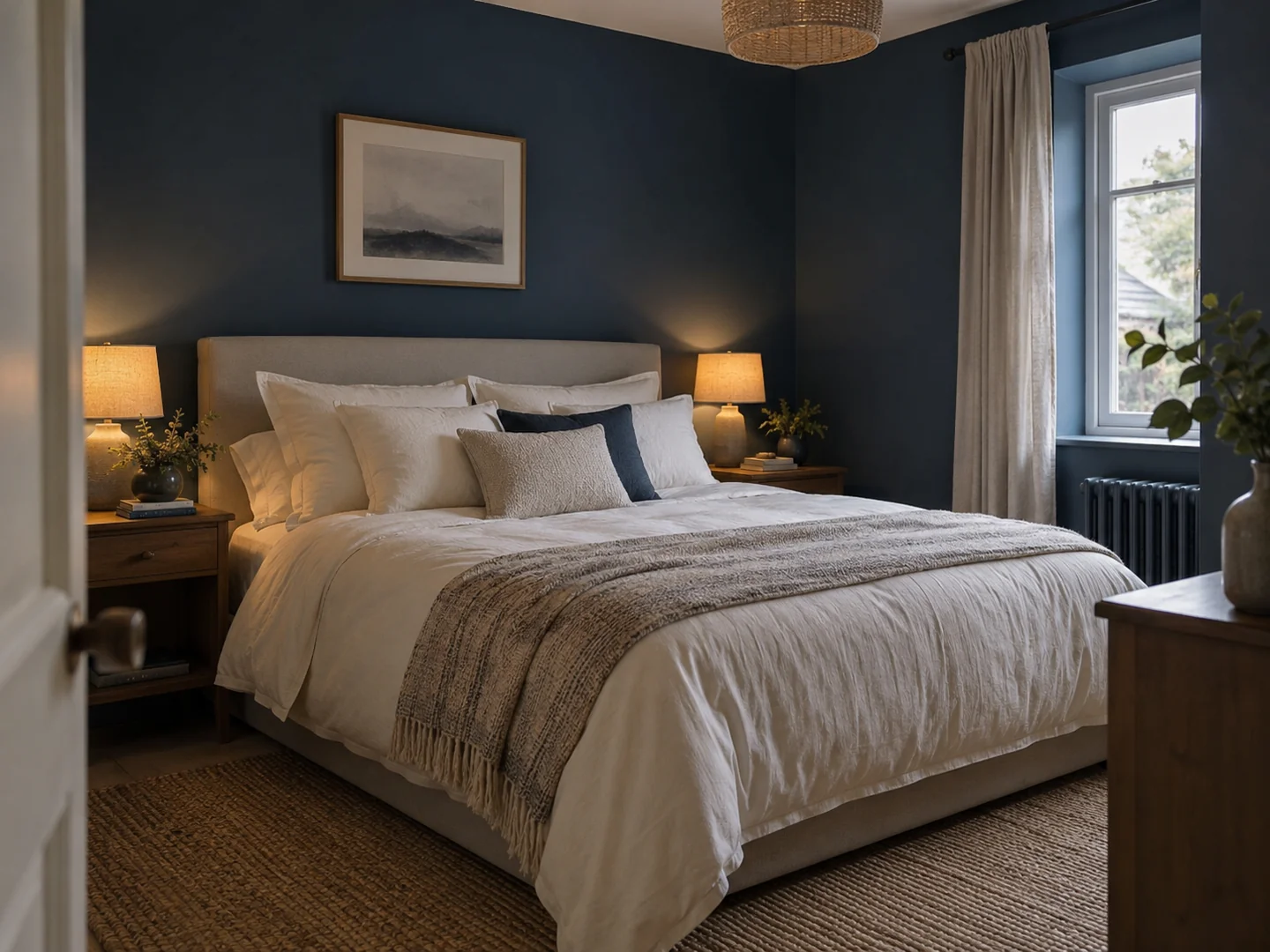
What do you want to see at night?
A dark bedroom can feel enclosed in a way some people enjoy. Others find the same room heavy when they wake. Neither response is a design failure. Before buying paint, think about whether you want the bedroom to feel like a bright start to the day, a quiet evening retreat, or both.
Look at the permanent elements. White wardrobes, a pale ceiling and a large window frame will make distinct shapes against a deep blue or green wall. If you like that contrast, keep it. If you imagine a continuous cocoon of colour, those white surfaces need to be part of the plan rather than surprises after the walls are finished.
Take particular care with fitted storage. Repainting cabinetry may be a much larger job than painting walls, and it may not be appropriate for its material or finish. You can choose a wall colour that works with the wardrobe instead of extending a paint idea into a project you did not intend.
Test a useful area, not a tiny patch
Put a large painted sample near the headboard and another view of it beside the wardrobe. A small dark square surrounded by a white wall can look dramatic while telling you little about a whole room. Use the sample to assess the colour's character, then use a simple sketch or visual mock-up to consider the area it will cover.
Compare at least one less saturated or slightly lighter alternative. Sometimes the desired effect comes from a dusty mid-tone rather than a very deep colour. A dark teal, a greyed green and a charcoal blue can all feel quite different, even if the colour chart places them close together.
Spend time with the favourite in the morning as well as after sunset. If you only see the room under warm lamps, you may miss a daylight cast that bothers you. If the bedroom is used chiefly at night, do not reject a colour solely because it is less lively on a gloomy weekday afternoon.
Keep the useful contrasts
Bed linen is a large part of the room's visible colour. Ivory or pale striped bedding can give a dark wall a clear foreground without a collection of bright accessories. A darker bedspread creates a more continuous effect. Try existing bedding against the sample before buying anything new.
Reading, dressing and finding small objects still require suitable light. A dark scheme does not make dim lighting a requirement. Aim lamps where their light is useful and check the room with the wardrobe open. A pleasant glow in a photograph is not evidence that you can distinguish two navy shirts in the morning.
Pay attention to the lampshade too. A pale translucent shade may show as a bright object, while an opaque one sends light in more limited directions. Choose the combination that serves the bedside task and the room's appearance, following the fitting's bulb requirements.
Decide how far the colour travels
A dark wall with a white ceiling has a visible upper boundary. Carrying the colour across the ceiling changes that relationship, but it also changes the scale of the job. You do not need to do both to make the walls look intentional. A softer ceiling white or a related pale tone is another possibility.
Consider the door from each side. A dark bedroom door seen from a pale landing becomes part of the landing scheme whenever it is open. Record which faces and edges are to be painted if somebody else is doing the work.
The final test is modest: can you enjoy the room with ordinary bedding, clothes and the usual bedside objects in place? If the colour only works when everything else is hidden, choose a version that leaves more room for daily life. A bedroom should not need constant staging to hold its scheme together.