Move sideways past the sample
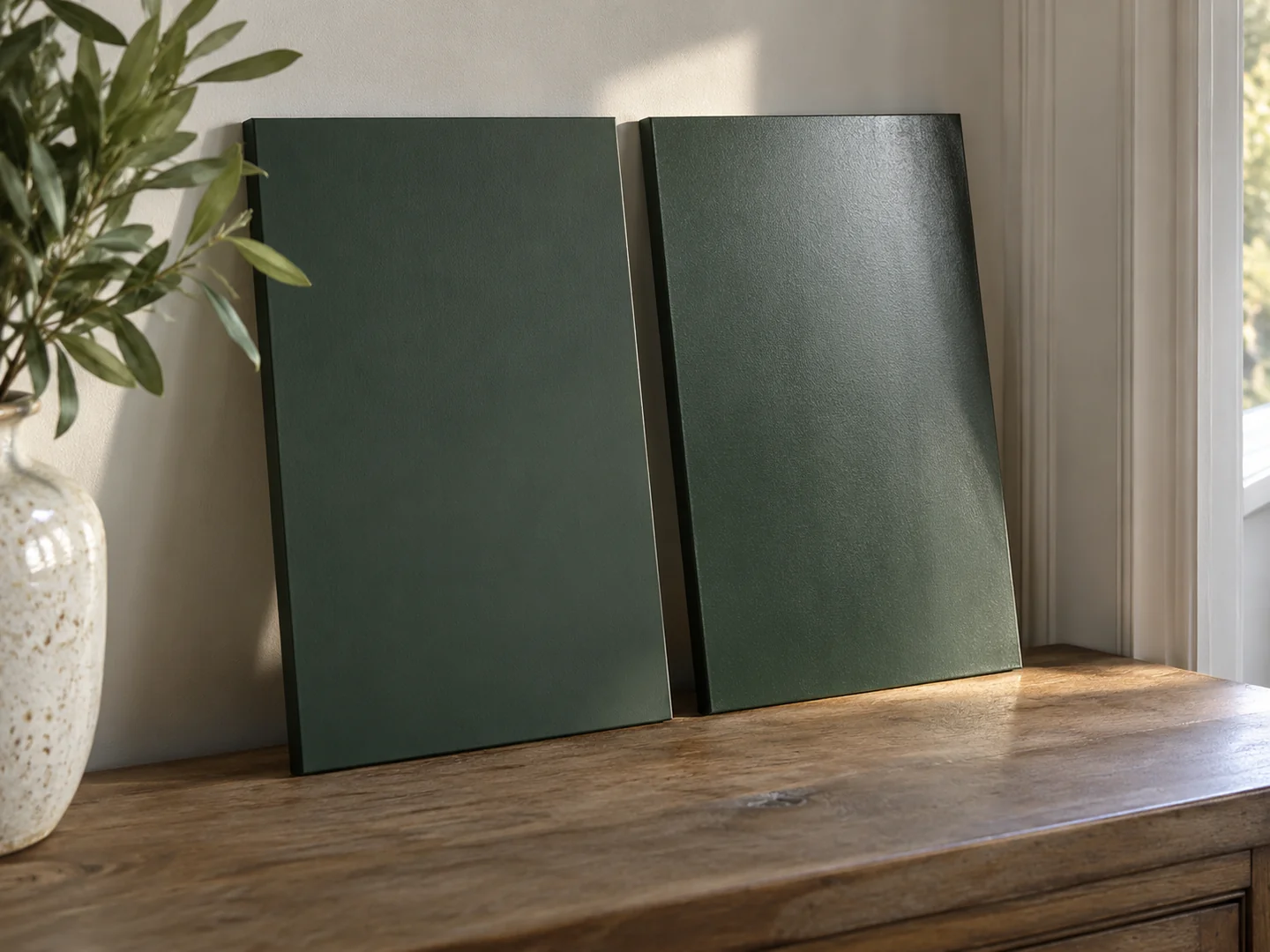
Two boards painted the same green can look different when one is matt and the other has a satin-like sheen. Face them directly and they may seem close; move towards the window and the reflected highlight becomes part of the shinier board's appearance.
This is why a sample in one finish cannot show every detail of a final product in another. It is still useful for choosing the colour family, but check the available finish and, where the distinction matters, see an example of that finish before buying the whole quantity.
A long wall lit from the side can reveal surface texture that is less obvious in even light. A stronger sheen may make those variations more noticeable. Dulux's finish guidance distinguishes the softer reflection of matt from more reflective finishes, but the actual effect still depends on the wall and the product.
Choose for the surface as well as the look
A wall, skirting board and kitchen cabinet have different demands. Do not use an unsuitable coating just to keep the same sheen everywhere. Read the product's intended surfaces, preparation and cleaning information, or ask the manufacturer about the exact application.
Finish names are not a complete durability scale. Some modern matt products are designed for cleaning, while others have different limitations. Check the specification instead of assuming that shinier always means more suitable or that every matt paint behaves alike.
If you plan to use the same colour on wall and woodwork, accept that different products may not look identical from every angle. That subtle change can help a moulding remain visible without a second colour.
Judge the room’s most revealing light
View the sample near the window and beneath the lamps used at night. A table lamp close to a wall may create a patch of sheen that was absent in the showroom. Move the lamp to its intended position before deciding whether that effect is welcome.
Consider repair and maintenance too. Keep the exact product and colour details after decorating. A later touch-up with a different finish can stand out even when the colour label matches.
Choose colour and sheen as a pair, then confirm the product suits the surface. That sequence avoids two common disappointments: a lovely colour with an unexpected shine, and a preferred appearance achieved with paint that was never intended for the job.