Empty one drawer, not the whole room
Lay out its contents and separate the things that genuinely belong there. Remove rubbish, duplicates you do not need and items with a better home. Then group what remains by how it is used. A drawer for household stationery may need a long space for scissors and rulers alongside smaller spaces for clips and stamps.
Measure the clear inside width, depth and height. Include any curve or mechanism that affects the usable area. A tray can fit the base yet catch the drawer above when taller objects are added. Check the drawer both closed and fully open.
A useful first arrangement can be made with suitable containers already in the home, provided their edges are safe and they fit without jamming the drawer. This lets you test the categories before buying a fitted organiser. You may discover that two broad compartments are sufficient and a detailed insert would only add restrictions. Replace temporary containers if they are flimsy or unsuitable for the contents; their purpose is to establish proportions, not to become a permanent compromise.
Divide unevenly
Use larger compartments for bulky or irregular objects and small ones only where they help. Too many tiny sections can make putting things away fiddly and reduce capacity. A flexible divider arrangement is useful when the contents change, while a fixed tray may suit a stable collection such as everyday cutlery.
Make sure the dividers stay in place during normal opening and closing. A loose organiser that slides to the back takes the contents with it. Choose a suitable non-damaging arrangement for the drawer and follow the product guidance, particularly with tension-fit dividers that press against the sides.
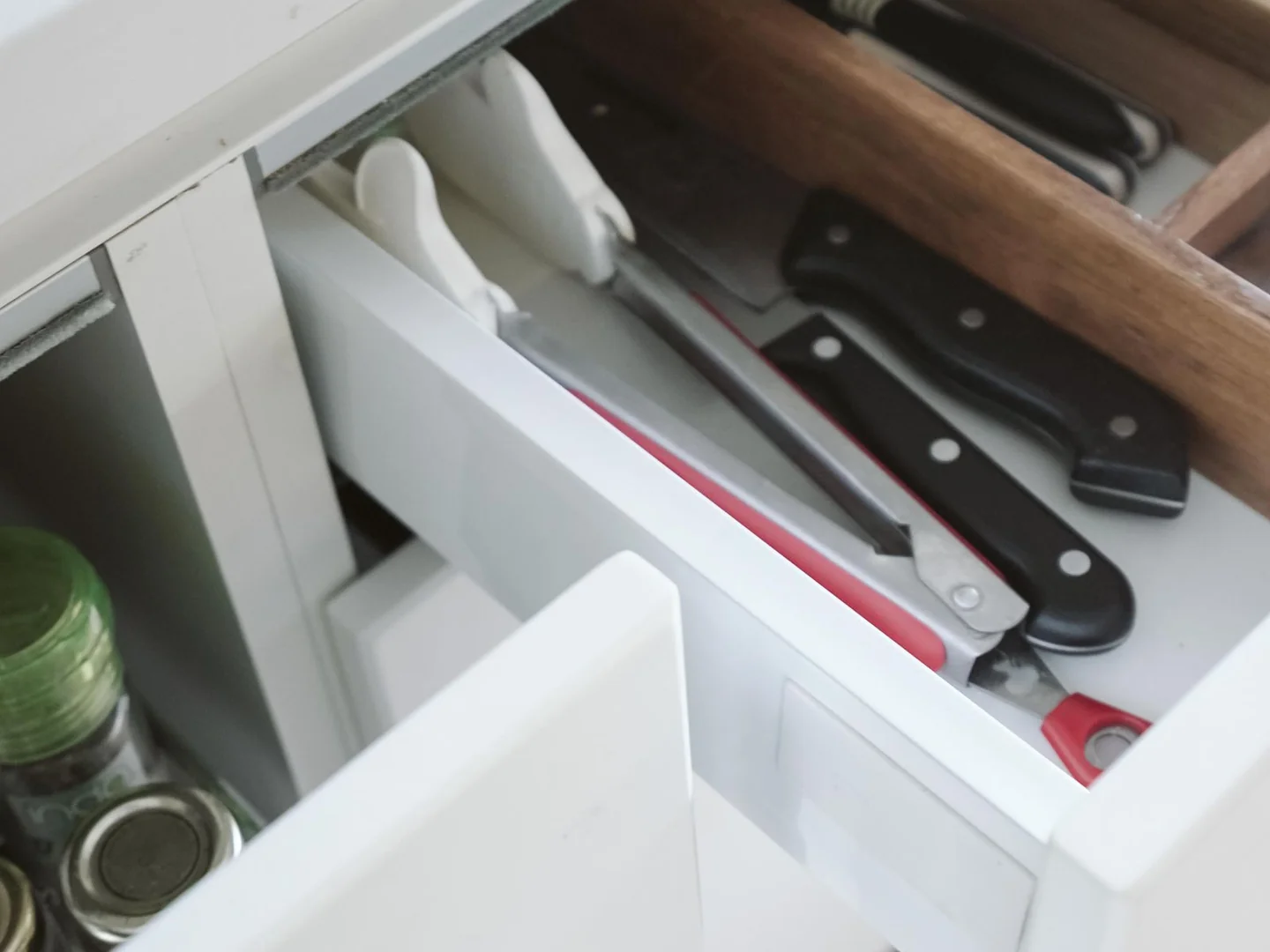
Avoid storing objects in a way that makes sharp edges difficult to see or reach safely. Tools, blades and cleaning products need storage appropriate to their use, not simply a compartment that happens to fit. Keep necessary labels and protective covers in place.
Test with the drawer partly full
Put the main groups back before buying every available insert. Use the drawer for several days and notice which compartment becomes crowded and which remains empty. Shift a divider in response to that evidence. The aim is not to preserve a particular grid but to make the objects easy to see and return.
If miscellaneous items keep arriving, name a limited space for them or identify where they actually belong. Expanding the drawer's job indefinitely will defeat any organiser. A small tray for current loose items can be useful, provided it is reviewed rather than treated as permanent storage for every unexplained screw and cable.
Take a quick photograph once the arrangement works if several people share the drawer. It can clarify the categories without elaborate labels. A successful drawer usually looks ordinary: enough space for each group, no need to lift several layers and no difficulty closing it after something is put back.