Separate everyday pairs from the rest
Count the shoes that regularly arrive at the front door, not every pair in the household. Daily trainers, work shoes and a pair of boots may need easy access, while occasion shoes can live elsewhere. A hall cabinet becomes crowded quickly when it is expected to contain the entire collection.
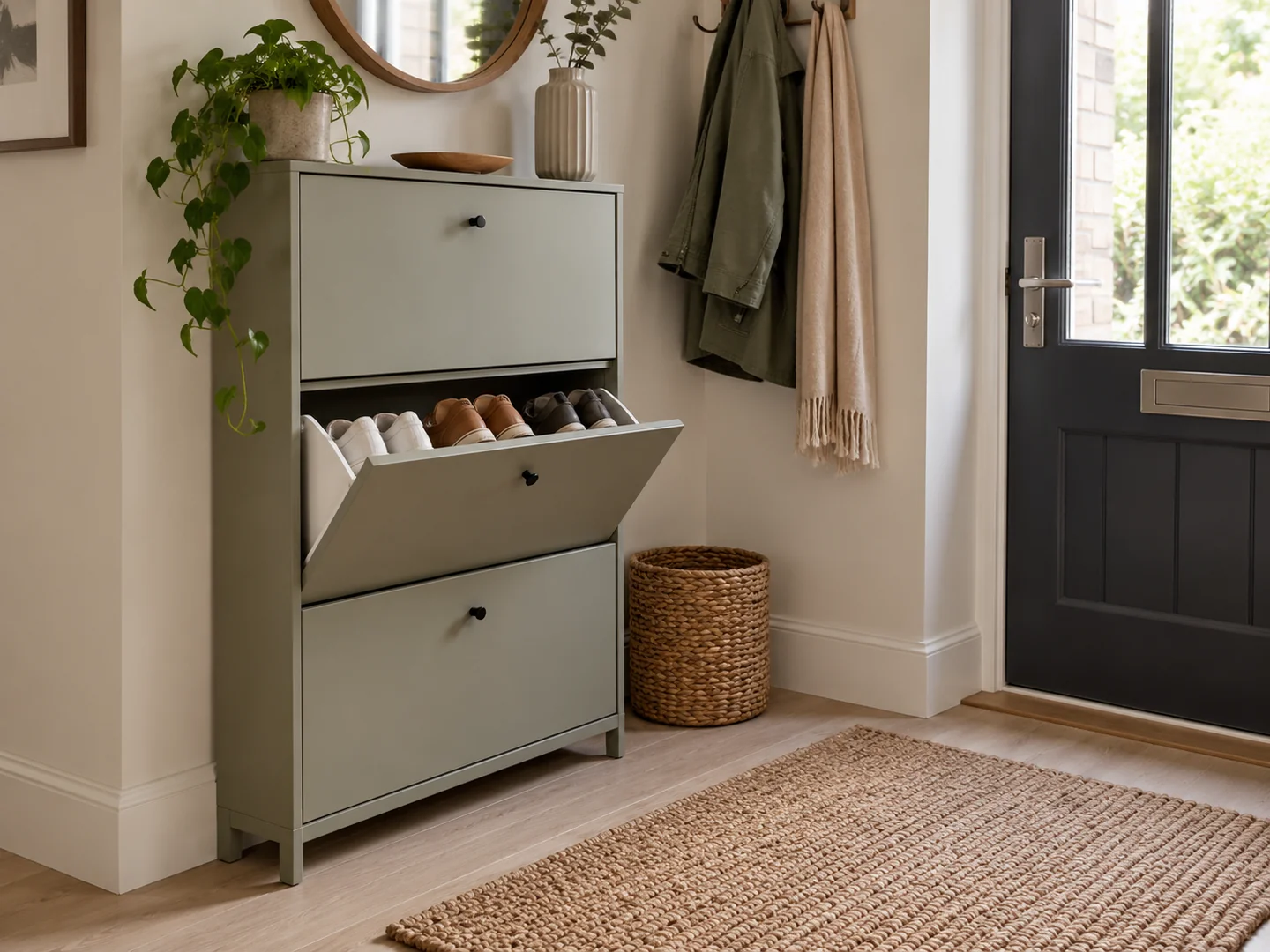
Allow for the shape of the shoes. High boots, broad trainers and large sizes may not fit the compartments used to calculate an advertised pair capacity. Measure the largest everyday pair and compare it with the internal space. A tilt-out cabinet can be shallow overall but still unsuitable for the footwear you use most.
Include the opening movement
Open a tilt compartment or drawer on the plan and see what remains of the passage. Somebody needs to stand in front while putting shoes away. A cabinet that fits when closed may block the front door in use. Check the door handle and skirting as well as the wall-to-wall width.
Follow the cabinet's fixing instructions. Some slim shoe units depend on wall attachment and are not intended to stand loose. If the available wall cannot accommodate the required installation, choose another system rather than leaving the unit unsecured.
An open rack can make daily shoes easier to return, but it leaves them visible and collects dirt beneath. Choose a form that allows the floor to be cleaned without unloading everything. A tray for wet footwear can be useful nearby, provided it lies securely and does not become another obstacle.
A bench with storage can combine putting shoes on and putting them away, but check both jobs separately. The seat needs to suit the person using it and the unit must be designed to support sitting. Doors or baskets beneath it should remain accessible without requiring somebody to stand in the front door's path. If the bench is too deep for the hall, a smaller shoe cabinet and a seat elsewhere may be a more workable pairing. Combining functions helps only when neither function becomes awkward.
Give the system a realistic limit
Leave enough room to put shoes away without arranging them precisely each time. A cabinet filled to theoretical capacity may require more effort than a busy household will give it. Slightly fewer pairs in accessible positions often stay organised longer than maximum storage packed tightly.
If shoes gather beside the cabinet, look at why. The opening may be awkward, the relevant shelf may be full or the boots may not fit. Moving the same pile back every evening will not correct a mismatch between the storage and the footwear.
Review the entrance when seasons change. Move unused pairs to a suitable dry place and bring forward what is being worn. This is a small adjustment, not a need for a larger cabinet every time the weather changes. The best hall storage leaves the front door easy to use while giving current footwear an obvious place to return.