Look inside before designing compartments
Empty the cupboard enough to see its floor, walls and ceiling slope. Note meters, pipework, controls and any inspection access. These are not leftover gaps to be concealed behind storage. Maintain the clearances and access required for the equipment, and obtain appropriate advice before planning joinery around services.
Check the condition of the space too. Dampness, leaks or an unexplained musty smell need attention before belongings are packed back in. Storage containers cannot correct a building problem. Avoid enclosing electrical or heating equipment in an improvised compartment or using the area in a way that conflicts with its intended access.
Measure the doorway as well as the interior. A large box may fit beneath the stairs but fail to turn through the opening. The lowest rear section can be difficult to reach even when its volume looks generous on paper. Sketch a side view showing where the height becomes too low to stand or crouch comfortably.
Put the awkward shapes in first
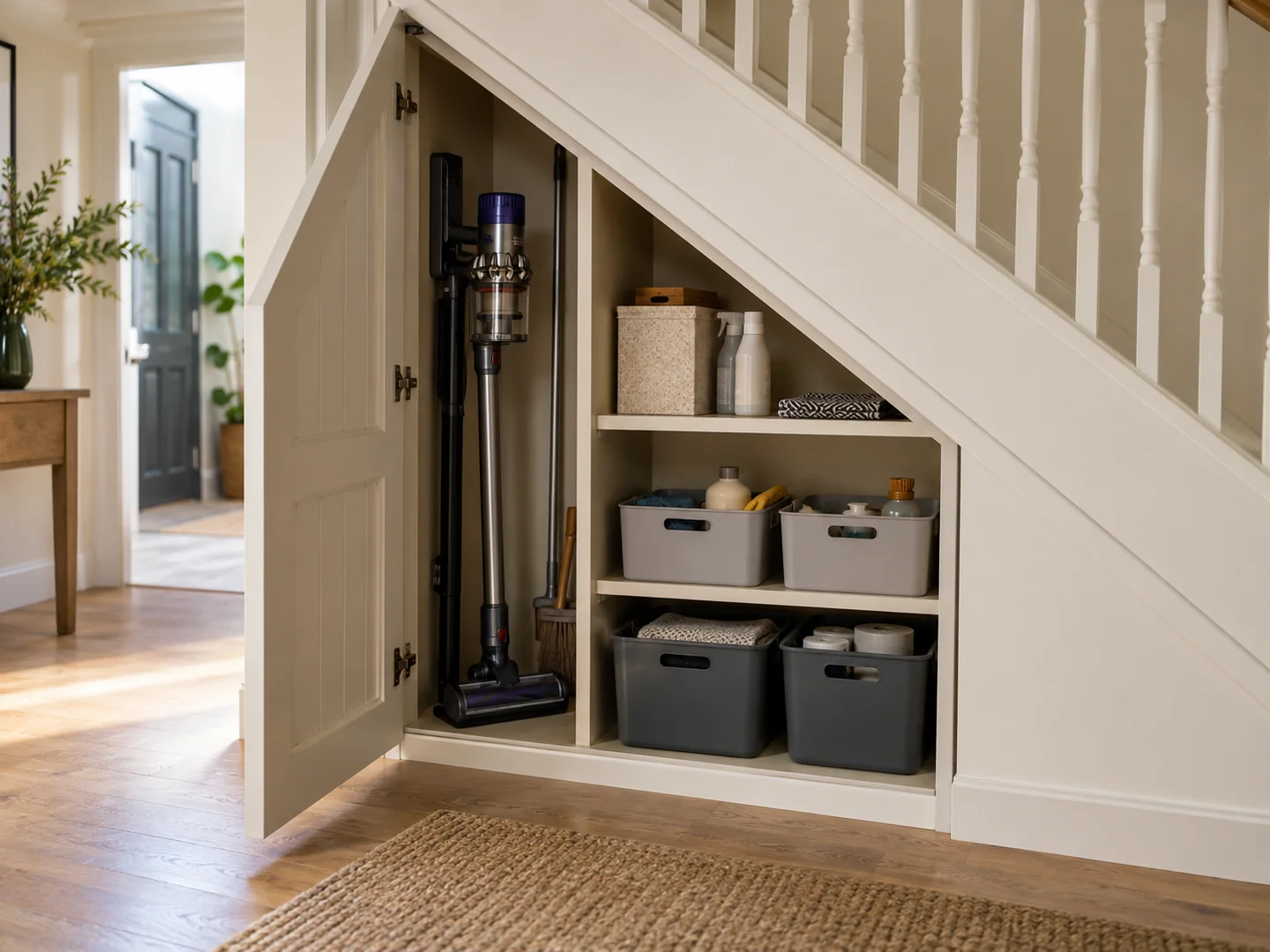
A vacuum cleaner, ironing board or folded drying rack often determines the arrangement. Measure the items in the form they are stored, including handles, hoses and attachments. A vacuum with a projecting head may need a different footprint from its upright body. Give it a position that can be reached without unloading smaller boxes.
Reserve the tallest usable area for things that genuinely need height. Smaller items can occupy shelves or containers elsewhere. Filling the front with shallow baskets may look tidy while forcing the largest object to lean across the whole cupboard. Solve the bulky items before buying organisers for the remaining spaces.
Consider how an item leaves the cupboard. An ironing board may need to tilt before it can turn through the door. A folded chair might catch a shelf edge. Test these movements with temporary shelf positions or cardboard guides before commissioning fixed divisions.
Let frequency decide the depth
Everyday objects belong near the entrance and within comfortable reach. Rarely used, lightweight items can occupy the lower or deeper spaces if they remain identifiable and retrievable. Avoid burying essential household equipment behind seasonal decorations simply because the boxes stack neatly.
Use smaller containers in deep sections so one can be removed without moving an entire packed mass. A handle should face the opening, and the container needs room to clear the shelf or slope. A box that fits perfectly with no finger space may be surprisingly difficult to retrieve.
Labels are most useful where the contents cannot be seen. Keep them specific enough to distinguish similar boxes: spare bulbs and small electrical accessories do not need the same container as furniture fittings. Retain safety information and original packaging where it is necessary for an item's safe use or identification.
Choose shelves that follow the contents
Equal shelf spacing is not automatically efficient beneath a slope. One taller compartment and several shallow ones may suit the collection better. Adjustable shelves allow changes, but their load limits and fixing system still matter. Do not assume an extra shelf can carry the same weight if its supports differ.
Pull-out storage can improve access, provided it is designed for the opening and the weight carried. Check the full extended footprint in the hall and whether somebody can stand beside it. A drawer that blocks a door or main route may replace one access problem with another.
Keep heavy objects in positions where they can be handled without awkward lifting. Do not store large loads overhead merely because the upper triangle appears unused. The cupboard should suit the people retrieving the objects, including any mobility or strength limitations, rather than seeking the greatest theoretical capacity.
A deep shelf can be divided into a reachable front area and a removable rear box, but the rear contents should be genuinely occasional. Write down what belongs there and choose a container that can pass through the cupboard opening when full. If the back requires crawling under a low slope, consider leaving it unused instead. A small amount of unclaimed volume is preferable to an arrangement that asks someone to retrieve a heavy box from an uncomfortable position whenever the seasonal decorations are needed.
Test putting things back
An arrangement is not complete when everything has been fitted inside once. Remove the three items used most often and return them in a different order. If a hose has to be coiled precisely or a box balanced at an angle, the system may be too tightly packed for ordinary use.
Leave a modest amount of spare room where objects change shape or arrive temporarily. A shopping bag, a newly purchased supply or a damp umbrella should not automatically land on the floor because every compartment is full. Be selective about which of these items belongs in the cupboard at all.
Photograph the finished arrangement while it is clear, then use it as a record of where larger objects belong if the space is shared. There is no need to maintain a showroom display. The worthwhile result is a cupboard whose difficult shape has been acknowledged, whose services remain accessible and whose ordinary contents can be returned without a small rearrangement every time.