Measure more than the opening
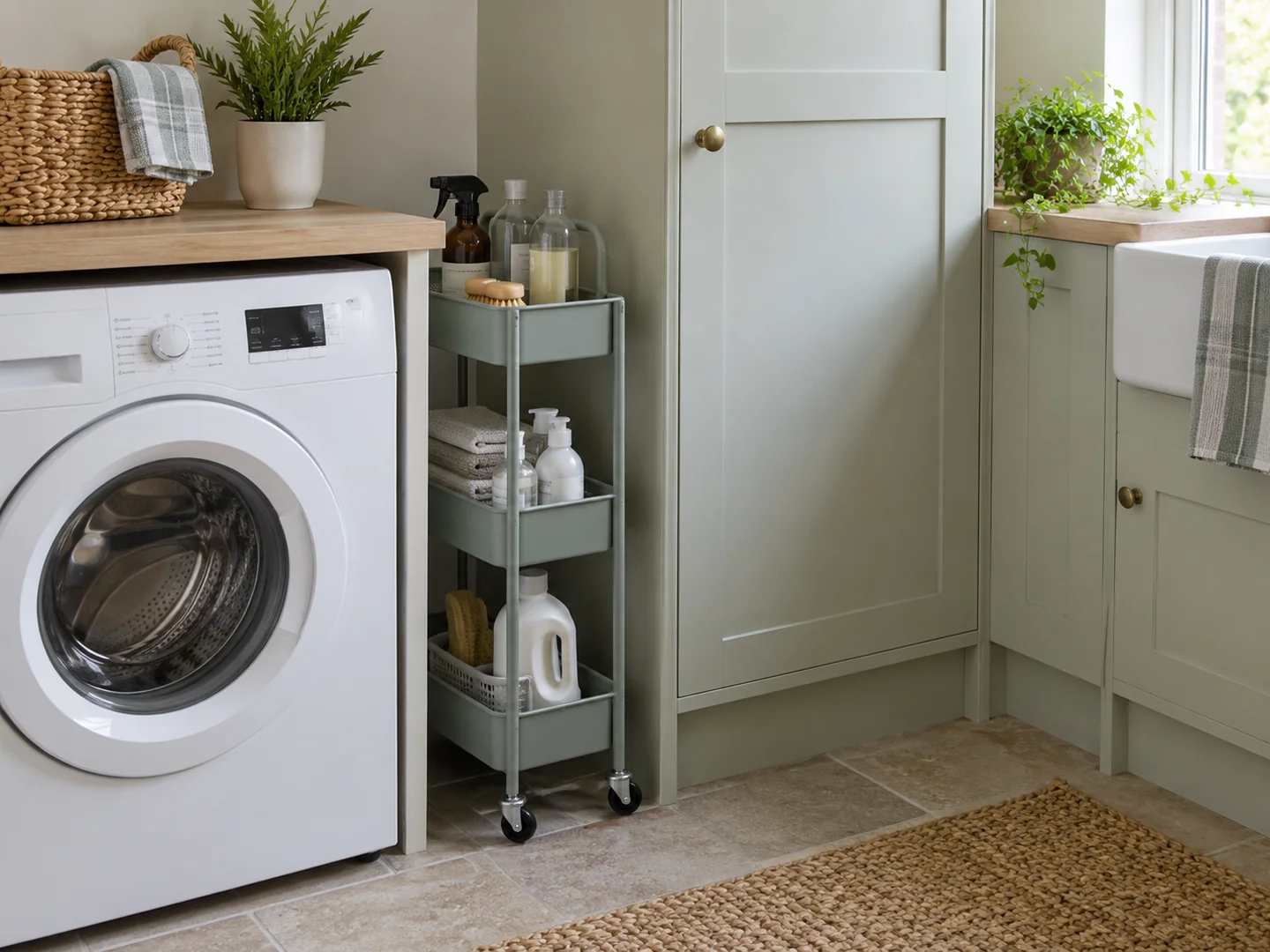
Check the gap at the front and back and at several heights. Skirting, pipes or handles may reduce the usable width. A trolley's wheels and handle can project beyond its trays, so compare the widest assembled dimensions rather than the shelf width alone.
If the gap is beside an appliance, preserve all clearances, ventilation and access required by its manufacturer. Do not wedge storage into space reserved for hoses, electrical connections or heat dissipation. The fact that a trolley physically enters the gap does not establish that the space is available for storage.
Pull it all the way out
The trolley needs a destination when opened. Test whether it blocks a door, the route through the utility area or an appliance door. A long, slim unit can be awkward to turn in a small room even though its stored footprint is minimal.
Check the floor transitions. Castors may catch on a threshold or thick mat, making the contents wobble. Use the trolley within its load limits and place items so it remains stable. A tall bottle on the top tray changes the arrangement more than a folded cloth.
Decide what belongs there before filling every level. Frequently used light supplies may be convenient; heavy liquids or items with specific secure-storage requirements may need another location. Keep products in their original packaging with instructions visible.
Inspect the tray sides before storing small objects. A shallow rim may not contain items while the trolley moves, particularly over a floor joint. A suitable small container can help, but it should fit securely without making the trolley top-heavy. Test movement with the intended contents instead of an empty frame.
Leave a workable gap
A little clearance makes it easier to pull the unit out without scraping the surrounding finish. If the fit is extremely tight, a narrower trolley or no trolley may be the better decision. An awkward sliver of floor is not wasted simply because it remains empty. It may be providing the access and separation the nearby equipment needs, and that function is more important than squeezing in another row of bottles.